Devices
Do continuous glucose monitors tell healthy people anything?
CGMs are transformative in diabetes. In people without it, they mostly measure things whose significance nobody has established.
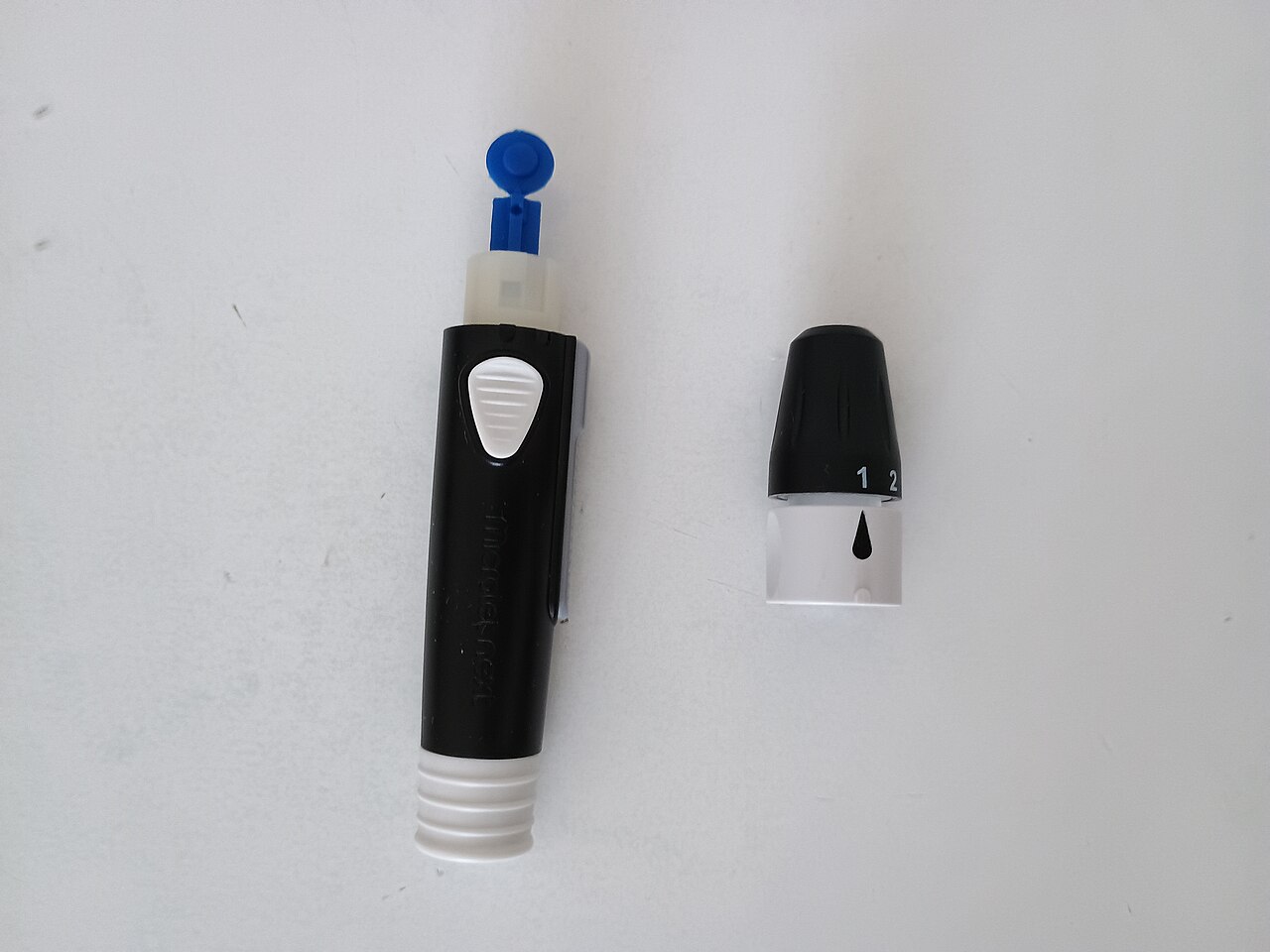
_Blood_glucose_meter_03.jpg)
What a CGM measures
A filament in interstitial fluid, sampled every few minutes, converted to an estimated blood glucose. Two consequences follow. It lags blood glucose by several minutes, which matters when values are changing rapidly. And it is calibrated for the diabetic range, where accuracy requirements are different from resolving small fluctuations in someone whose glucose never leaves the normal band.
What is well established
In diabetes, the case is clear. Hybrid closed-loop systems improved both glycaemic and psychosocial outcomes in randomised trials [7], and CGM has been used to compare drug effects on variability directly — empagliflozin versus metformin, for instance [2]. Mesenchymal stem cell trials in diabetes have used it as an endpoint [5]. These are the applications the technology was built for.
CGM in diabetes
What is not established in people without diabetes
Three claims are made routinely and none has trial support:
- That spikes in a non-diabetic range are harmful. Postprandial glucose rises after eating. That is the system working. No trial has shown that a normal-range excursion causes harm.
- That flattening your curve improves health outcomes. No randomised trial in people without diabetes has shown benefit on any hard endpoint from reducing variability.
- That your personal response identifies foods that are bad for you. Response varies with sleep, stress, prior meals, exercise, sensor position and the sensor itself. Two sensors worn simultaneously frequently disagree meaningfully.
What genuinely changes the curve
Some findings are solid and interesting. A low-carbohydrate breakfast produces a lower postprandial response than a low-fat one [4] — unsurprising but well demonstrated. A high-protein breakfast changes the postprandial profile [6]. The DASH4D trial examined diet effects on glycaemic control and variability in a structured way [3].
The most surprising: a randomised trial found natural daylight during office hours improved glucose control [1]. Light exposure is a circadian variable, not a dietary one, and it points at how much of glucose regulation sits outside what you ate. Related reading on our sleep evidence site.
When a CGM is genuinely useful without diabetes
- Prediabetes, where you are tracking a real clinical trajectory.
- Reactive hypoglycaemia symptoms, where correlating symptoms with actual readings is diagnostic.
- Genuine curiosity, honestly held, with realistic expectations about what a fortnight of data can tell you.
- Behavioural feedback, which is the most defensible use — some people eat better when something is watching, and that is a valid reason even if the glucose data itself is uninformative.


Common questions
Is a glucose spike after eating bad?
Should I eat to keep my line flat?
Why did the same meal give different results?
Can a CGM detect prediabetes?
References
Every citation below links to the original peer-reviewed record on PubMed or via DOI. Nothing here is a substitute for medical advice.
-
Effects of short-bout accumulated physical activity and sedentary-break interventions on continuous glucose monitoring metrics in adults with type 2 diabetes: A systematic review and meta-analysis Cao S, Wang H, Zhu Y, et al. · Frontiers in endocrinology · 2026 · Meta-analysis DOIPubMed 42798338Full text
-
Maternal high-protein/low-glycemic-index diet during pregnancy impairs offspring lipid profile-a randomized controlled trial Mogensen CS, Magkos F, Chabanova E, et al. · European journal of nutrition · 2026 · Randomised controlled trial DOIPubMed 42417833Full text
-
Natural daylight during office hours improves glucose control and whole-body substrate metabolism Harmsen JF, Habets I, Biancolin AD, et al. · Cell metabolism · 2026 · Randomised controlled trial DOIPubMed 41418772
-
Empagliflozin versus metformin for glucose variability and metabolic outcomes in drug-naïve type 2 diabetes: The EMPA-FIT study Lim S, Park CY, Jeong IK, et al. · Journal of diabetes and its complications · 2026 · Randomised controlled trial DOIPubMed 41223492
-
Interaction of melatonin receptor 1B (MTNR1B) genotype and type of breakfast (protein-enriched v carbohydrate-rich) on postprandial glucose response: a randomised crossover trial King A, Nixon J, Kapellou A, et al. · European journal of clinical nutrition · 2026 · Randomised controlled trial DOIPubMed 42521769
-
Effect of a Personalized Mobile App on Glucose Control in Adults With Prediabetes and Type 2 Diabetes: Exploratory Pilot Randomized Controlled Trial Lalama E, Csanalosi M, Kabisch S, et al. · JMIR human factors · 2026 · Randomised controlled trial DOIPubMed 42342244Full text
-
Sleep Optimization to Improve Glycemic Targets in Adults With Type 1 Diabetes: A Randomized Controlled Parallel Intervention Trial Martyn-Nemeth P, Duffecy J, Steffen AD, et al. · Diabetes care · 2026 · Randomised controlled trial DOIPubMed 42149583Full text
-
Relationship Between Sleep and Meal Timing with Glycemia Parameters in Individuals with Obesity Participating in a Randomized Time-Restricted Eating Study Reutrakul S, Simon SL, Wang Q, et al. · Nutrients · 2026 · Randomised controlled trial DOIPubMed 42280467Full text
-
Understanding the Metabolic and Endocrine Effects of Macronutrient Boluses in the Context of a Low-Carbohydrate Diet: A Randomized Crossover Study Deru LS, Bailey BW, Hales KE, et al. · Nutrients · 2026 · Randomised controlled trial DOIPubMed 42654249Full text
-
DASH4D diet for glycemic control and glucose variability in type 2 diabetes: a randomized crossover trial Fang M, Wang D, Rebholz CM, et al. · Nature medicine · 2025 · Randomised controlled trial DOIPubMed 40764427Full text
-
In-Hospital Diabetes Management by a Diabetes Team and Insulin Titration Algorithms Based on Continuous Glucose Monitoring or Point-of-Care Glucose Testing in Patients With Type 2 Diabetes (DIATEC): A Randomized Controlled Trial Olsen MT, Klarskov CK, Jensen SH, et al. · Diabetes care · 2025 · Randomised controlled trial DOIPubMed 39887698
-
Use of real-time continuous glucose monitoring in non-critical care insulin-treated inpatients under non-diabetes speciality teams in hospital: A pilot randomized controlled study Thabit H, Rubio J, Karuppan M, et al. · Diabetes, obesity & metabolism · 2024 · Randomised controlled trial DOIPubMed 39169520
-
Continuous Glucose Monitoring Profiles and Health Outcomes After Dapagliflozin Plus Saxagliptin vs Insulin Glargine Simonson DC, Testa MA, Ekholm E, et al. · The Journal of clinical endocrinology and metabolism · 2024 · Randomised controlled trial DOIPubMed 38412282
-
Impact of a Low-Carbohydrate Compared with Low-Fat Breakfast on Blood Glucose Control in Type 2 Diabetes: A Randomized Trial Oliveira BF, Chang CR, Oetsch K, et al. · The American journal of clinical nutrition · 2023 · Randomised controlled trial DOIPubMed 37257563
-
Efficacy of Umbilical Cord-Derived Mesenchymal Stem Cells in the Treatment of Type 2 Diabetes Assessed by Retrospective Continuous Glucose Monitoring Zang L, Li Y, Hao H, et al. · Stem cells translational medicine · 2023 · Randomised controlled trial DOIPubMed 37738447Full text
-
Effect of a High Protein Diet at Breakfast on Postprandial Glucose Level at Dinner Time in Healthy Adults Xiao K, Furutani A, Sasaki H, et al. · Nutrients · 2022 · Randomised controlled trial DOIPubMed 36615743Full text
-
Effect of a Hybrid Closed-Loop System on Glycemic and Psychosocial Outcomes in Children and Adolescents With Type 1 Diabetes: A Randomized Clinical Trial Abraham MB, de Bock M, Smith GJ, et al. · JAMA pediatrics · 2021 · Randomised controlled trial DOIPubMed 34633418Full text
-
Improved Glycemic Control and Variability: Application of Healthy Ingredients in Asian Staples Camps SG, Kaur B, Lim J, et al. · Nutrients · 2021 · Randomised controlled trial DOIPubMed 34578981Full text
-
Continuous Glucose Monitoring in Very Preterm Infants: A Randomized Controlled Trial Galderisi A, Facchinetti A, Steil GM, et al. · Pediatrics · 2017 · Randomised controlled trial DOIPubMed 28916591
-
Comparison of low- and high-carbohydrate diets for type 2 diabetes management: a randomized trial Tay J, Luscombe-Marsh ND, Thompson CH, et al. · The American journal of clinical nutrition · 2015 · Randomised controlled trial DOIPubMed 26224300
-
Continuous Glucose Monitoring for Prediabetes: What Are the Best Metrics? Zahalka SJ, Galindo RJ, Shah VN, et al. · Journal of diabetes science and technology · 2024 · Review DOIPubMed 38629784Full text
-
Complications of Diabetes and Metrics of Glycemic Management Derived From Continuous Glucose Monitoring Yapanis M, James S, Craig ME, et al. · The Journal of clinical endocrinology and metabolism · 2022 · Review DOIPubMed 35094087Full text
-
Continuous Glucose Monitoring and Physical Activity Schubert-Olesen O, Kröger J, Siegmund T, et al. · International journal of environmental research and public health · 2022 · Review DOIPubMed 36231598Full text
-
Continuous Glucose Monitoring Profiles in Healthy Nondiabetic Participants: A Multicenter Prospective Study Shah VN, DuBose SN, Li Z, et al. · The Journal of clinical endocrinology and metabolism · 2019 · Journal article DOIPubMed 31127824Full text